On this page
- Rinse aid does the work of letting water sheet off; about 3.5 drops go in per wash, and a full dispenser lasts about 30 washes. 1
- Streaks: lower the dose. Spots and wet dishes: raise it. 13
- Thermador's web page says all its dishwashers dry by condensation; the DWHD660EFM manual describes Zeolite drying. 13
- Etching cannot be reversed; hard-water film can. The vinegar soak separates the two. 1
Why do my dishes come out wet or spotted from a Thermador dishwasher?#
The common causes on Thermador's list are too little rinse aid, a cycle that has no drying, dishes loaded flat so water sits on them, and a detergent with weak drying performance. Plastics are slower than glass in any case. 1
The support page gives the checks in that order: raise the rinse aid setting, confirm the cycle includes drying, arrange the dishware in a sloping position, and try another detergent or add rinse aid. On select models an Extra Dry option adds heat to the final rinse; your owner's manual says if it exists. 1 The DWHD660EFM manual has its own drying options page, including a Star Dry option that extends drying time. 3
How does a Thermador dishwasher dry the dishes?#
Thermador's web page says every Thermador dishwasher uses condensation drying: a very hot final rinse heats the dishes, the stainless steel tub cools faster, and moist air turns to droplets on the tub wall and drains next cycle. 1
The DWHD660EFM manual describes something different for that model: a Zeolite container holds a mineral that stores moisture and gives the heat back during the drying phase, blown into the tub with dry air. 3 The two documents are not about the same model line, so check which one fits the plate on your unit. What they share is the part that matters to you: the dishes dry because they are hot and the water can run off, which is why rinse aid and loading angle count.
On the Zeolite model, do not set dishware directly in front of the container's intake or outlet openings, and do not put heat-sensitive items in front of the outlet. 3
How do I refill the rinse aid and set the amount?#
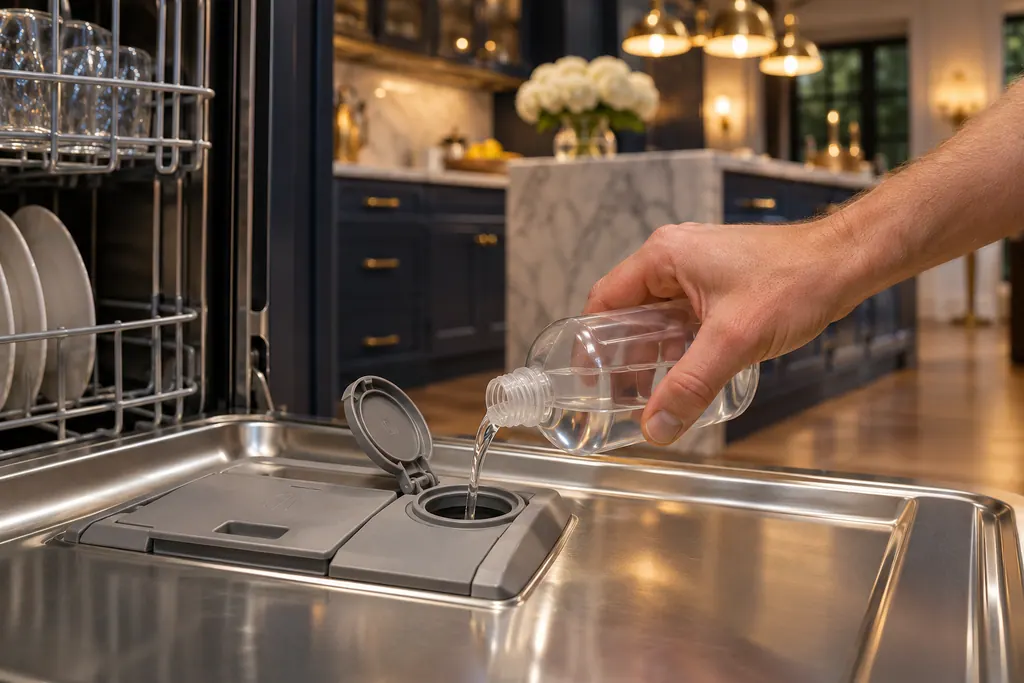
Open the dispenser lid with the latch, pour rinse aid to the max line, wipe any spill, and close the lid until it clicks. On the DWHD660EFM, you change the dose in the basic settings; the factory value is r:05. 23
- 1
- 2
- 3
- 4
- 5
A lower value adds less rinse aid per wash and reduces streaks. A higher value adds more, reduces water spots and improves the drying result. 3
What if I get streaks instead of spots?#
Reduce the amount of rinse aid. Thermador's page says so directly, and the DWHD660EFM troubleshooting table lists an overly high rinse aid setting as one cause of removable streaks on glasses and silverware. 13
Streaks also come from the opposite problem: no rinse aid at all, which the manual lists beside it. 3 So look at the reservoir before you turn the dial. If the dispenser is empty, fill it first and see what the next cycle gives. A detergent with a built-in rinse aid has limited effect, and the manual says you generally get better results with a separate rinse aid. 3
Is cloudy glassware hard water or etching?#
Put a cloudy glass in a bowl of vinegar. If the cloudiness disappears, hard water caused it; if it stays, the glass is etched, and etching is permanent. 1
For hard water, Thermador's page says to adjust the detergent amount to your water hardness, perhaps raise the rinse aid, and check whether your model uses softener salt. 1 For etching, prevention is all there is: do not pre-rinse, use a light cycle for glasses and use only the detergent your load needs. 1 The manual agrees on pre-rinsing, to save resources and because the sensors then pick a lighter cycle. 3
| What you see | Likely reading | First move |
|---|---|---|
| Wet dishes, plastics worst | Low rinse aid, no drying option, flat loading | Raise the dose; tilt dishes 1 |
| Water spots on glass | Hard water or too little rinse aid | Vinegar test; raise the dose 1 |
| Removable streaks | Dose too high, or none | Lower it, or fill the reservoir 13 |
| Cloudiness that stays after vinegar | Etching | Prevent for next time; it cannot be cleaned off 1 |
| White film in the tub | Limescale | Descale the dishwasher 1 |
How should I load the dishwasher so water runs off?#
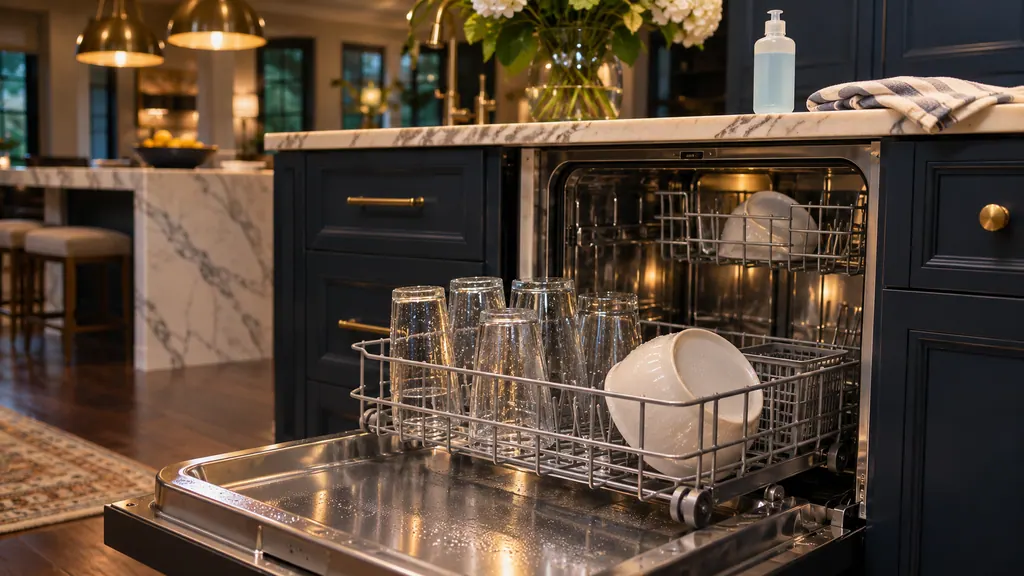
Angle cups and glasses, set bowls on their sides, keep large pans and platters along the outer sides of the lower rack, and do not nest utensils. The manual adds that curved items and openings should face down or tilt. 13
Thermador's loading entry also tells you to mix forks and spoons so they do not nest, and to put knives blade down in the basket. 1 The manual says heavily soiled dishes belong in the lower rack, containers should have openings facing down so no water collects, and spray arms must turn freely. 3 If you are unsure, spin each arm by hand before you start; they should rotate freely. 1
After the cycle, open the door slightly and let the dishes cool for a few minutes before unloading, starting from the bottom to avoid dripping water on the rest. 3
When does a wet or dirty result point to a real problem?#
When the display shows an E: code that returns, when the tub still holds water once a wash has finished, or when dishes stay wet with drying, rinse aid and a clean filter in place. A small amount of water around the filter is normal. 13
An E:21-30 reading on a DWHD660EFM points to dishware covering the Zeolite intake; Thermador's web page reads E2130 differently, as a fan motor problem, and our code row for E2130 shows both. 3 Our guide to dishwasher number formats explains the two spellings. Rinse the filter under lukewarm water with a soft brush before you decide anything else; a clogged filter is on Thermador's list for poor washing. 1
Which results mean the dishwasher itself needs attention?#
A returning E: code after reloading, a tub that holds water after every cycle, a door that leaks with the seal and feet checked, or dishes that stay wet even with drying, rinse aid and a clean filter. 13
Ask for a technician when you reach that point. Loading and dosing are yours to adjust, so a visit begins with the same checks listed above and then tests the machine. Repairs that fall under Thermador's own warranty stay with Thermador. Pricing is settled with you first and confirmed after diagnosis; the dishwasher service page describes what is covered.
Sources#
- Appliance Features | Dishwashers Support | ThermadorThermador (thermador.com, US support site) · Page undated; retrieved 12.11.2026 · Accordion entries on loading and rinse aid, cleaning and drying results, condensation drying
- How to Refill Rinse Aid | Appliance Features | Dishwasher Support | ThermadorThermador (thermador.com, US support site) · Page undated; retrieved 12.11.2026 · Page text, four-step refill
- Use and care GUIDE: Dishwasher DWHD660EFMThermador (BSH Home Appliances), en-us edition · File tag 9001862916_C · PDF pages 9-10 (Zeolite drying), 17 (options), 22-23 (rinse aid system), 24-25 (loading), 33 and 36-37 (troubleshooting)